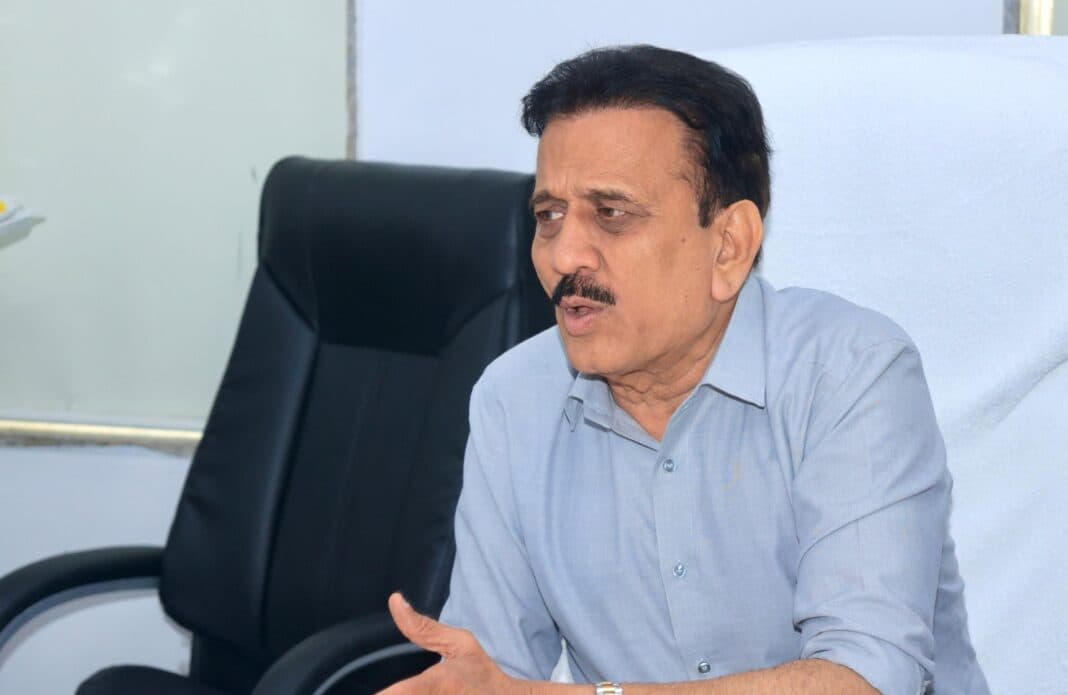
Mumbai, 21st: Maharashtra has become the first state to adopt the state-of-the-art weather forecasting system, the ‘Bharat Forecast System.’ This initiative is expected to bring about significant improvements in weather advisories, local-level preparedness, and coordinated response mechanisms. Disaster Management Minister Girish Mahajan stated that the agreement signed with the Indian Institute of Tropical Meteorology (IITM) for this purpose marks a pivotal milestone in further strengthening Maharashtra's disaster management capabilities.
The Maharashtra State Disaster Management Authority (SDMA) has signed a Memorandum of Understanding (MoU) with the Indian Institute of Tropical Meteorology (IITM), Pune. This collaboration is set to substantially enhance the state's pre-disaster preparedness and its capacity to respond to weather-related calamities, such as torrential rainfall.
Under this agreement, the indigenous ‘Bharat Forecast System’ (BharatFS)—developed by the Government of India's India Meteorological Department (IMD) as part of its ‘Mission Mausam’ initiative—will now be directly integrated into the state's decision-making processes. The system will be operationalized through the State Emergency Operations Centre (SEOC) and the Geo-spatial Decision Support System (GeoDSS).
With this initiative, Maharashtra has emerged as the first state in the country to significantly bolster its disaster management and early warning systems by leveraging advanced data analytics and operational workflows. The BharatFS system is capable of generating highly granular and high-quality weather forecasts for specific 6 km × 6 km grids. Consequently, precise weather information will now be accessible down to the Gram Panchayat and sub-taluka levels. This represents a major advancement compared to the 12 km × 12 km resolution forecasts that were previously available.
This system will facilitate faster and more effective preparedness measures against various disasters, including heatwaves, torrential rains, storms, floods, and landslides. Weather-related information will be updated every three hours, providing near real-time data regarding rainfall, maximum and minimum temperatures, atmospheric pressure, wind speed and direction, as well as cloud cover.
Under this initiative, citizens will have access to high-resolution weather forecasts at three-hour intervals, Impact-Based Forecasts (IBF), and an automated alert system. Furthermore, a facility will be available to simultaneously disseminate notifications through sirens, mobile messages, and public broadcasting systems. This will significantly enhance the effectiveness of delivering timely warnings to citizens, reaching even those at the last mile.
Vinita Singal, Principal Secretary of the Department of Disaster Management, Relief, and Rehabilitation, stated, "This collaboration will make decision-making processes at the state and district levels faster and more data-driven. Consequently, the early warning system will become more effective, facilitating the seamless dissemination of information to citizens right down to the last mile."
Dr. Bhalchandra Chavan, Director of the State Disaster Management Authority (SDMA), remarked, "Through this collaboration, scientific weather data will be placed directly in the hands of district administrations and local agencies, marking a significant and effective step toward ensuring the safety of citizens across the state."
Citizens are urged to regularly obtain weather forecasts, disaster preparedness updates, and emergency notifications through the official channels of the SDMA. The emergency response and relief helpline numbers are: SDMA 1070, DDMA 1077, and Ambulance/Medical Emergency Services 108.